Perfume by Patrick Süskind

Perfume by Patrick Suskind is a uniquely jarring book. The subject matter, although brilliantly poetic and creative, is definitely not for everyone. The sense description is wonderfully immersive. It has a certain tone and atmosphere that is incredibly unique. I almost want to describe it as romantic (in the poetic sense). However, the descriptions of the girls were objectionable. Due to the discussions around this book, I new that it wouldn’t be the most comfortable read, but for someone a little more ignorant to the subject matter, it may be entirely off-putting.

Admittedly, it was a hard book to stay involved in. From the pedophilic descriptions to scenes that read like filler, I didn’t find that the concept was enough to carry the book along. That was until parts 3 and 4. These latter stages of Grenouille’s life were the most obsessive and climactic. They were certainly the most engaging and definitely worth persevering for. I felt that the end was just what the book needed, making it absurdly memorable.

Overall, this is a classic for a reason. The language and atmosphere is well crafted and the overall structure of the book is entertaining. That being said, for me, some scenes did become a little tedious and the descriptions of the girls were unpleasant. I likely wouldn’t read this book again but I’m glad I’ve got another classic ticked off my list.

3/5

The Girls Who Grew Big by Leila Mottley

‘The Girls Who Grew Big’ by Leila Mottley is quite possibly one of the most impactful novels I have read within this last year. It focuses on a group of young women, all in different stages of motherhood and life as a whole. It is not only compelling but a beautiful homage to women everywhere.

Lost and alone, a group of women found each other and created a community, headed by Simone. Drawing only from personal experiences, they pull each other through life and showcase the gritty determination of love. I believe it is very easy, not only for authors but also the general public, to reduce a woman to motherhood as soon as they have a child. Mottley didn’t. Instead, she made a point of fleshing them out, making them real, and exposing the deepest parts of them. With their distinctive voices and interchanging POVs, the readers get an excellent insight into The Girls and their levels of self awareness. They become a friend to the reader, a companion. You can so easily place yourself into any of their lives. This is a skill crucial for a book of this nature as it humanises teen/young mothers in a way I haven’t seen before.

My favourite character, by far, was Simone. To me, she encapsulated the power of a woman. A compassionate and nurturing nature guarded by strength and a willingness to do anything for those she loved. She wasn’t a stereotype nor was she a half-hearted ‘girlboss’. She was entirely herself, shielded from all but the reader. 

The writing was so raw, emotional and full of a rich sense of self. No description was too ‘on the nose’. Instead, it was imaginative and playful while also carrying the seriousness of the situations The Girls found themselves in. Nothing was trivialised or romanticised, it was a harsh, honest, and confronting read but one that was a real eye opener. Especially for those brought up to judge teen mothers or those who are poor. 

While the plot initially seemed directionless, it was full of colour and twists. There was a slow burning of tension and a believability to the scenes that was just so compelling. It immediately draws you in. There was an excellent balance between tense, dramatic scenes and calm ones. With consistent underlying emotional weight, it is a heavy book to read but not one that would bore easily.

The only criticism I can note would be some unexpected darker scenes. They seemed to come without warning and it was quite a shock. There were some instances, mainly in Emory’s life, where things were mentioned but not really followed-up on. If I had to ask anything more of this book, it would be to dig deeper into the psychological repercussions of those experiences.

Overall, ‘The Girls Who Grew Big’ is destined for success. Leila Mottley’s writing is profoundly beautiful and I would give anything to read this book for the first time again. If you are looking for a book that will showcase the raw reality of womanhood, this is for you. Just be warned, there are a few harsher scenes that may cause distress so proceed with mild caution!

5/5

Missing Hour by Robert Rutherford

‘Missing Hour’ is a fabulous book written by Robert Rutherford about a woman looking to avenge her husband over a scheme that goes deeper than she could ever imagine. After discovering the unsavory dealings of a company called HELIX, Maggie Brewer’s life seems to turn upside down. From the moment I started reading the book, I was hooked.

The descriptions and overall writing style is excellent, submerging you in the story right away. One of my favourite descriptions was “fine rain jewels the air” located at the beginning of the book. An excellent technique Rutherford used was the main character, Maggie Brewer, being written in first person while all the other characters were in third person. This immediately highlights her as the most important character and gives the readers a deeper insight into the story. Her feelings allow the readers to see the plot from a different angle and allows for her characterisation to flourish. The little light hearted comments scattered throughout also really added to it, keeping the book undulating with emotion.

Another excellent aspect of this book is the dialogue. It feels very real and rarely pulls you from the story. It adds a lot to the believability of the characters and pairs well with their realistic characterisation. Throughout reading, it was very easy to create an image of the characters, even without specific descriptions. This is something I just love in a book. I particularly liked the uneasy atmosphere around Declan Clay, a murderous helping hand to the leader of HELIX. His soft Irish accent was the complete juxtaposition to his actions and that translated very well over the page.

The tension is probably my favourite part of this book. Having Maggie’s first person account of her emotions adds so much to the scenes. While the tension continued throughout, it never became tiresome. The pace was fast and the situations were described wonderfully, adding or removing detail depending on the moment. 

Finally, the complexity of the plot is brilliant. I started reading, thinking it would be a simple thriller novel but I couldn’t have been more wrong. While, at times, the explanations of HELIX and its associated businesses were complex, it was not too hard to understand overall. I just wish there was more time to digest the information before a new piece was thrown at you.

In conclusion, Missing Hour by Robert Rutherford was excellent. It is fast paced and full of twists. The constant dialogue from Maggie paired with the more light-hearted comments kept the book varied with emotion and provided some release from the heavier scenes. If you love a book with beautiful descriptions and wracked with tension, this one is definitely for you!

4/5

Confessions by Catherine Airey

Confessions by Catherine Airey is a book about the lineage of women and their messy yet realistic lives. It begins with Cora, talking about the death of her mother and then later, her father. It is an intriguing opening to the book, sampling the expert and complex characterisation that continues throughout. It sets up a narrative in which personal stories told by each of Cora’s family members is interspersed with mysterious snippets of a game called ‘Scream School’. There is no part of this book that is not entwined with another, and while that may be briefly confusing for on and off readers, it overall adds a brilliant layer of complexity to the novel.

The most notable feature of this book would be, of course, the characters. Throughout, each have a consistent voice and a distinct personality which carries through. One of my favourite parts is the fact that, no matter how far removed they are from one another, they each are connected in some way. This is through obvious things like relation but also through small physical details such as Michael, Cora’s father, buying fries so she could dip them into her milkshake and then how Cora’s daughter, Lyca does the same for her crush Sanjeet. As the book progresses, there are notable dynamics which are very interesting. The first I picked up on was the mother-daughter dynamic in which the daughter occupies the role of the parent. This is seen in Cora mothering Marie due to her mother’s mental struggles and how she loved reading Alice in Wonderland together as that was the only time Marie would “behave like a normal mother”. This unorthodox relationship is also mirrored in Cora being emotionally managed by Lyca. At first, I found it odd that Lyca would only call her mum by her first name but as the story progressed it becomes clear as to why she managed her Mum’s immaturity the way she did.

Due to the intricacies of their demeanours and the explicit nature of their own personalities, each character comes across as fully developed and realistic which allows for believable connections between them. The battle between Roisin and Marie for Michael’s affection is palpable yet also very subtle. The dysfunctional nature of their sisterly dynamic is the underlying theme throughout the book and that was something I enjoyed thoroughly. Reading Roisin’s perspective on her childhood both through her youth and old age is a brilliant way to keep the readers engaged. Roisin’s story had the ability to stagnate due to her not encountering many significant changes in her life yet her sections of narration were wildly entertaining. The theme of familiarity and its slow development really added a solid backbone for this book. This allowed for more comedic elements to shine which is needed in what otherwise would be considered a ‘heavy’ novel. Mini insights to the characters like Marie not allowing Cora dolls but then letting her own a flashlight-doll hybrid adds so much to their development. I constantly found myself relating to the characters, like Lyca believing that if you looked away from a loading screen it would load faster, and thus found myself becoming more invested in their storylines.

Each character had a chance to narrate their own point of views and that is something I always love in a book. It highlights the unreliability of each character and gives the readers a deeper insight into their personalities. This was done especially brilliantly in Marie’s portions of the book. Her complex mental health struggles created the most wonderful dynamic between reader and narrator as she was incredibly dysfunctional to read about. Her portions being written in second person rather than first, like the others, separates her from the rest of the story and further highlights that dysfunction. Although, it was confusing to read at first. She was by far the most enjoyable character to follow along with, however, there were some instances of abuse which I believe the readers should be warned about before reading, such as the substance and sexual abuse.

Furthermore, the unreliability of each narrator and the sudden changes of time periods did confuse me a couple of times and thus made it hard for me to get totally invested. I found myself constantly trying to refer to previous sections of the book to find out what the connection was to my current chapter. Having two connecting instances/people at either end of the book did somewhat take away from the tension of the mystery and leads the reader feeling less satisfied with the reveal. That being said, seemingly untied loose ends were explained nicely in Lyca’s section at the end of the book and were therefore rounded off well. Additionally, interspersing snippets from the Scream School game did drag out the tension but also created a mystery of its own. It allowed for a break between emotionally taxing and complex plotlines which was very needed. It’s mystery was also rounded off well in Lyca’s portion of the book, I just wish that there were more hints about where it was going to keep up my interest. Yet where the plot structure faltered, the language didn’t. It kept the book feeling fresh with each sentence and was entirely dynamic. Descriptions were done in magnificent detail while not being ‘overly flowery’ or filled with adjectives. Instead, it described emotions and scenes perfectly and in a way that was easy to read. I especially enjoyed the portion where Marie went to her university friend’s family home for Thanksgiving and their whole dynamic ended up symbolising American gluttony. Writing like this adds another layer of the realism that really is the core of this book.

In conclusion, if you want to read a book with no idea of where its going, read this one. If you want to become completely invested in a whole jumble of characters, read this one. While it does have moments where it loses its tension or chronological narrative, in the end you’ll have found that you have read a perfectly satisfactory book. At that point, I urge you to read it again because I am sure that you’ll pick up on new clues you didn’t find the first time.

Rating: 4/5

Sexual Mishaps

It was the night I first prayed, properly anyway. Down on my hands and knees, nestled by the toilet and begging the so called ‘good lord’ to do something.

Having a misguided relationship with sex means you have a misguided relationship with everything. It led to assault of every variety, a mental and sexual ambush. Well, that’s in my experience anyway.

When you’re hurt deeply, irreversibly, you find the kindness of man a pantomime. A concurrent flurry of manipulative daydreams bent on luring you in again and again. I’ve fallen for it more than once, settled in the fact that all I have to give is what others want to take. It’s a dangerous path to go down but one that’s unavoidable when someone begins to take from you. Stealing rose after rose until you’re only left with thorns.

I not only lost myself but the world around me. It all became a fakery. I was walking through a painting splashed with the shakings of disassociation. Travelling on the bus became more than a chore, it became a feat of man and one I had to conquer every day. It was a wonder I managed to get anywhere, mellowed in a near meditative state of depersonalisation. I was no longer real to the world. My place was void.

On the bathroom floor I had hoped it would all change. I hoped that I would wake up in my cold bed and there would no longer be those shadows behind me. Their kind faces, soft hair, slender fingers. That was, of course, not my reality. I had awakened in a sweat and the shadows were still there.

I don’t know if they’ll ever dissolve, fall into the earth like blowing the steam from a boiling kettle. But I know that those calls, those conversations, the reams of writing about my past will help. That’s what I was told anyway. Learn all you can about yourself, dig deep for the scars in your muscles and knead them out with a self kindness that still seems so foreign. One day, I hope, it will all fade. I don’t need God. I only need myself.

Tell Me What I Am by Una Mannion

SPOILERS AHEAD

‘Tell Me What I Am’ by Una Mannion is an excellent example of how to write a good character. In a book where a mother, Deena, goes missing, her sister Nessa must uncover the secrets of her disappearance while also attempting to contact her niece, Ruby, after she was won in a custody battle. Ruby has no recollection of her former life nor her mother, having been fed lies by her narcissistic father, Lucas. The book surrounds Ruby and Nessa’s journey towards the truth, both having to overcome their own personal struggles as well has the world around them.

Nessa is a woman very attached to her past, so much so, it deeply affects her relationships. I like how Ronan, her boyfriend, wasn’t written as her ‘saviour’ nor as a quick fix to an all-encompassing problem. He tried to help Nessa only to be turned down. Nessa actively sabotaged her relationship with him because the weight of her sister’s disappearance was too crushing despite how close she and Ronan were. He signified a part of her past in which she couldn’t get back and so she had to let him go. I really like this element of their relationship as it adds a more realistic feel to the writing. It is very rare for a relationship, especially one with physical distance between the pair, to withhold in the face of intense and traumatic pressure like what Nessa and Ronan went through. To see their relationship flourish in the midst of this pain would both be unrealistic and out of place in my opinion. However, you can still see their connection with Ronan showing up to Lucas’ pretrial despite getting married to someone else. Nessa, as an independent character, is also very well written. She is stubborn and devoted to Deena and Ruby, so much so, she puts herself at risk both physically and mentally. Throughout the book, I found myself longing for her to successfully contact Ruby as she was a consistent mothering/nurturing figure throughout the book, something Ruby desperately lacked. Ruby, in a way, is written like Nessa, especially with the self-sabotaging of relationships but through no fault of her own. Her not messaging back Tim because time slipped by, due to her being consumed with her mother’s disappearance, is very realistic and makes her feel human. Allowing characters to make mistakes makes them a more engaging figure to follow throughout a book. As a result, I found that as a reader, I connected with her more and felt more sympathy towards her plight. Mannion writes younger characters incredibly well, catching their aging via dialogue and how their internal thoughts and external speech matures. She also writes a subtly narcissistic character brilliantly too. Although it is already determined that Lucas was an unfavourable person and even worse partner, Mannion doesn’t just use statements like “Lucas was abusive” as the sole piece of evidence of his poor character. She notes his controlling behaviours subtly through dialogue and description like the narration commenting on how he doesn’t like his mother, Clover, having the TV too loud, noting how he “loved [Deena] mimicking his phrases”, or even how he didn’t enrol Ruby into school. Ruby’s fear of having his truck pull up tells us all we need to know; he is a fear-inducing figure, far exceeding the levels of a normal authoritative parent.

This use of language and description doesn’t just help with character development but also the plot as a whole. While refraining from being overly complex, the writing still contains a good level of description to get your imagination whirring. There are motifs in the book that frequently reoccur like that of the angel or the moving of boats. Subtle elements that are noted in the background really build up the scene and give it that realistic feel. For example, Ruby noting that she was a clam in a school play, Nessa referencing the joeys in a nature documentary she saw when Ronan hugged her, and Nessa practicing her ‘bitch face’ for if one of Lucas’ lawyers looks at her again. These elements build the scene and develop the characters indirectly. They also, in some cases, like Ruby being a clam, add an air of hilarity to the writing which lightens the mood and makes the book feel less emotionally strenuous which therefore makes an easier read. In addition, the inclusion of the story of Gentileschi and how it relates to Deena was a wonderful addition which is indicative of the further research that Mannion had to do to flesh out this book.

The only areas of the book that, in my opinion, have room for improvement, are the pacing and certain parts of the plot. While there are elements like the end of chapters that leave readers on a mini cliff-hanger, rounding off the scenes nicely without being too intense, the overall pacing of the book is perhaps a little too drawn out. The constant changing of POVs is a nice addition as it showcases the drawing together of Ruby and Nessa, revealing information to the readers that Ruby is unaware of. Yet it is used too much. Towards the end, it started to drag and made me feel as though the climax was never going to happen. When it did, it was somewhat underwhelming. The reveal that Deena was dead was just shoved in. We only got to see Ruby’s reaction to the news, not Nessa or her brothers. Clovers big explanation at the end seemed like a quick solution for the book-long mystery and Lucas’ ‘craft’ seemed to have no character or depth. It came off as very generic. I also think that a book ending without readers getting to see whether Lucas was sentenced left it feeling unresolved. It could have perhaps been remedied by Nessa and Ruby finally meeting but it only briefly referenced.

That being said, overall, the book was very entertaining. The most important elements were all covered with the characters being really well developed and the writing style entertaining throughout. Yes, end the book felt rushed but that doesn’t take away from the positive elements. Regardless, people aren’t going to stop reading something because the ending is a little off, especially since the good characters and language is still there and the plot is too engaging to not find out what happens.

If you like a mystery thriller that showcases incredibly well written women then I suggest you give this one a go. It doesn’t have an overly complex plot to follow so it makes for an easier and more entertaining read.

4/5

Trust Your Eyes by Linwood Barclay

Yet another brilliant book I’ve read by Linwood Barclay that kept up its intensity while maintaining a digestible pace.

First and foremost, the entire concept of an untrustworthy, schizophrenic, agoraphobe witnessing a murder on a street-view map is so intriguing. It creates the space for many possibilities, one Barclay expertly filled. I enjoyed the switching of POVs and flashbacks, rarely creating confusion due to clear indicators of the time having gone backwards. The language was also clear and kept very simple all the while carrying a lot of descriptive weight. It didn’t ever become muddy and unrealistic nor did it sound as though Barclay was trying too hard to sound intelligent. The writing was just beautifully subtle.

Tension was built really well but teetered towards the longer side with the constant changing of POVs. However, I do not think that this is as bad as others have made out. Yes, it did make the tension more drawn out (risking the book becoming tedious) but it also highlighted the drawing together of the characters. It built up the anticipation for all of them to be aware of the other’s presence and to finally hit the climax where they’re all in the same room. As a result, the final conflict was incredibly satisfying and very hard to stop reading.

Another magnificent element of the book was how well the characters are written. Each had their own distinctive personalities which were slowly added to as the book progressed. Barclay does something I thoroughly enjoy in books, limiting character descriptions and instead focusing on their quirks, creating a more well rounded character. Their personalities are the most important thing and readers can get a sense of what they look like through them. For example, the assassin in the book is an ex-Olympic gymnast so you can assume that she is strong but lean. You can also gather that she is disciplined and perhaps even obsessive when it comes to her passions due to the rigorous trainings Olympians have to endure. Through this technique you focus on the important parts of the characters instead of simple hair and eye colour. Another brilliant example of this is Thomas and his maps. Thomas, the main character and the witness to the murder, is by far the best written character. Barclay captures that uncertainty Ray, his brother, feels when talking to Thomas excellently. You can feel Ray’s apprehension to trust his brother because you can see how unwell he is. Thomas speaks plainly to a point where, at times, it is humorous. His difference from the other characters is noticeable but also very subtle in a way where you almost start to believe that Thomas really is talking to Bill Clinton over the phone. That being said, I must admit that I did get confused between characters at some point. These were the characters who were in relation to Howard. I felt as though the more minor characters in that plot were introduced in a hurried way and not really developed. I’m aware that they are minor characters so they don’t need full personalities, but I felt that they weren’t written as clear as they could have been, leading to some confusion. However, saying this, it is important to note that I took large gaps in reading this book (not because of its quality but because life got in the way) so that was bound to have an impact on my overall comprehension.

As for the plot twist at the end, all I can say is wow, wow, wow. It truly emphasises how you never really know where the book is going. You can get some ideas and start to build up your own theories, but nothing is ever explicitly revealed or poorly hinted at, keeping your interest and wonder alive right until the last line. Its abrupt ending had a great impact and leaves you thinking about it for days afterwards. It truly encapsulates Barclay’s genius.

Overall, it’s safe to say that ‘Trust Your Eyes’ is an excellent and inviting book that throughly entertains you until the end. If the plot wasn’t enough to entice you, rest assured that the writing style and character development will carry you through. If you are a fan of thrillers and mystery, give this one a read.

The Clinic by Cate Quinn

Unfortunately, I couldn’t finish The Clinic by Cate Quinn. While there were some entertaining elements, like the distinct narration between characters and the plot concept, the writing felt very one dimensional. The female characters felt like cut out stereotypes with Cara’s only personality trait being that she is well mannered and Meg’s being addiction. No character felt fully developed and therefore, their connection with the reader was lost, making the book hard to read.
Additionally, I felt that the descriptive passages were full of a lot of unneeded adjectives which left nothing for the reader’s imagination. Even when it came to character descriptions, too much was listed all at once and it felt very superficial. Character quirks which can hint at both looks and personality (for example, nail biting-showing the state of the nails while also hinting at a more anxious character) were replaced with basic lists of hair and eye colours.
As previously mentioned, the plot itself is a brilliantly interesting idea and what first attracted me to the book. I just wish the writing was a little more developed. That being said, due to it’s more simplistic language and narration style, the book would be perfect for someone who is more invested in the action rather than the writing itself.

My First ‘Published’ Book

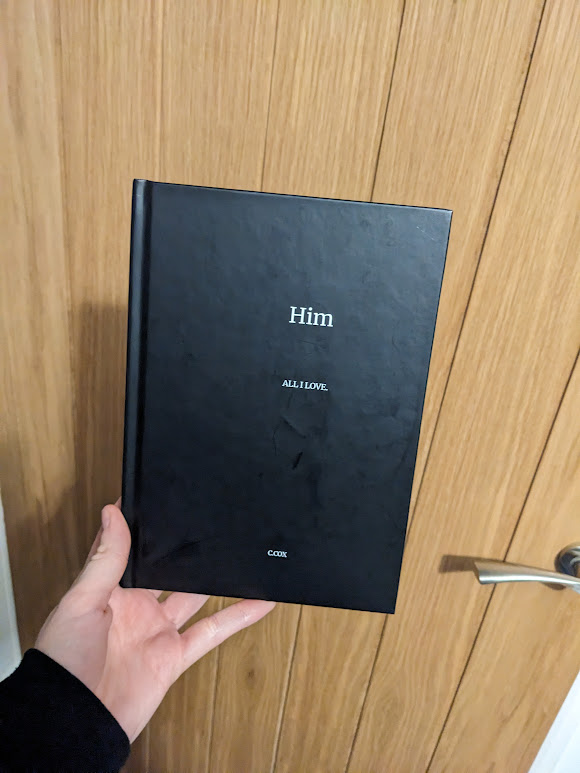
So, if you have seen my Instagram recently, you would be aware of the book I self published for my boyfriend’s Christmas present. It details all the things I love about him. This was my biggest and best present I have ever given anyone so I thought it would be fun to document the process here, maybe giving you guys some tips and tricks.

PLANNING

The planning was the easiest part, all I had to do was list the things I love about him. I then just used that as the order of each paragraph and boom, my outline was done.

WRITING

This was a little bit harder. As it was a present, I wanted this to be my best work yet so I had to work really hard on both my narration and descriptive skill. I wanted to link him to things I know we both find beautiful as well as describe different parts of him in ways I’m sure he wouldn’t have thought about before. This whole process took a month or two, with hundreds of revisions and edits (all done by me). I would advise you to 100% hire an editor if you are publishing for monetary gain because it’s very hard to find mistakes in your own work, especially if you read it over and over again!

The formatting of the document was also quite hard as I wanted each paragraph to be indented. I also wanted a contents page, numbered pages and everything to be aligned in the middle. When changing the size of the page (something I only had to do to fit the publisher’s requirements), the formatting changed with it so I would highly recommend making sure you get the page size right the first time. The contents and page numbers were easy though, Word has an abundance tools for you to use and a million online tutorials.

THE COVER

Some publishing sites provide you tools to make the cover while others leave you to it. I found a site that helped me make mine (one I have since forgotten the name of but will try to find). As their publishing requirements were too confusing for me, I just downloaded the cover I made and then used a different publishing site and then edited the sizing on adobe acrobat (using a free trial) in accordance to my chosen publishers requirements.

FINIDING A PUBLISHING SITE

I didn’t go to a ‘proper’ publisher for this as it was just a present. Instead, I looked into publishing companies which focused on gifts. I went through many, many websites all with varying degrees of help and prices. My biggest hurdle was figuring out the bleed margin and the sizing of it all (if anyone wants a tutorial on this, DM me). A company I found to be the most helpful was YouLovePrint, one I would highly recommend as they were both very helpful and affordable. When I sent over my initial word doc, my sizing was completely off so they sent me an email with an explanation on how to do everything. They broke it down really well and the whole thing became a lot less stressful afterwards.

However, new stresses arose in the form of word counts. I initially was very over the word count (by about 15 or so pages) and then, after I thought I had just gotten everything perfect, for YouLovePrint’s page requirements, I was criminally under. As I’m sure many of you do too, I hate cutting down my work and I especially hated it this time as it was all about my wonderful boyfriend! Although, just to note, I could’ve chosen a different bracket of page numbers provided by the company, but I thought 37 was a good number.

Once I finally got the pages in order, I then sent over my manuscript along with the cover and it began to be printed.

WAITING AND WAITING

It seemed like I was waiting forever for the product. In reality, I was probably only waiting for about one to two weeks. I was overjoyed when the product finally arrived at my door. Seeing the product almost made me cry, my own writing was made physical!

I was very lucky to receive two copies by YouLovePrint despite only ordering one. They came exactly as I had ordered them and in perfect condition.

PRESENT TIME!!

It was so hard to wait until Christmas to show my boyfriend the book but I thankfully held out. The surprise was wonderful and yet another time where I was fighting back tears. I am pleased to report that he loved it and it is now on display in our apartment!

The Trials of Marjorie Crowe by C.S. Robertson

The Trials of Marjorie Crowe is a book set in Kilgoyne, Scotland, the home of a supposed witch and four missing children. The locals all make the obvious, Hansel and Gretel fuelled, assumption that Marjorie must be the killer. As a result, she is sent on an uphill, seemingly fruitless, journey to prove that she is not.

This book was absolutely wonderful and entirely engaging throughout. The lyrical wording worked excellently with the pagan-like, naturalistic theming of the power of man and nature alike. It was entirely engrossing and really built up a vivid setting, especially since the real story of Julian Santana Barrera and his doll island was used. The use of hauntingly memorable stories like Barrera’s one added a great eerie atmosphere to the novel while Robertson also developed the less scary, spiritualist side as well. Overall, it became a very well-rounded piece which was easy to imagine and entirely engrossing.

Alongside the well-developed descriptions of the Scottish countryside, the characters were also developed fully which made for a believable and encapsulating read. Marjorie’s character subverted the word ‘witch’ from the Shakespearean stereotype to a portrayal of herbology and faith. This was perhaps the most compelling part of this book, allowing the readers to get an education of the history of witches (with interspersed stories of Marjorie’s ancestors) as well as an appreciation for nature. I also finished it with an appreciation of the author’s dedication to researching witches and their history, including elements like lay lines and widdershins. Reading this, I knew I would be educated in more ways that one.

Each major character was portrayed as a well-rounded human. They had personality, they had interests, and most importantly, they could make mistakes and still have good within them. I particularly liked the character of Soapy Moary whose true identity went unidentified until the last hundred pages. Despite being a larger, stronger man (presenting as traditionally masculine), Robertson had no problem conveying his vulnerability which made him both more likeable and believable. His interactions with Marjorie, although largely from a distance, still showcased an outstanding amount of chemistry. Other relationships within this book were equally as developed but were ranging in connection. As she was considered a murderer by her neighbours, Marjorie had very few positive relationships and her feelings about that were conveyed in a wonderful way. The first person perspective allowed the readers to get captivated by her opinions and unique narrative which really helped the conflict and tension flourish.

C.S. Robertson has a fantastic way of steering the reader to believe an outcome will be predictable then, at the last minute, making the narrative steer completely in the opposite direction. In mystery books like this, such a skill is both necessary and heavily appreciated, allowing readers to be fully engrossed and constantly thinking about Marjorie, even after putting the book down.

I feel very lucky to have found this book.